
Governance Structure
Basic Approach
The Nikke Group recognizes that strengthening corporate governance is essential to improving corporate value in a stable manner over the long term. In accordance with our “Corporate Philosophy” and “Management Policies,” we aim to ensure corporate transparency and fairness and to manage the company in a way that earns the trust of diverse stakeholders, including our shareholders.
To clarify our approach to corporate governance, the Company has formulated the “Nikke Corporate Governance Guidelines.”
Overview of the Corporate Governance System
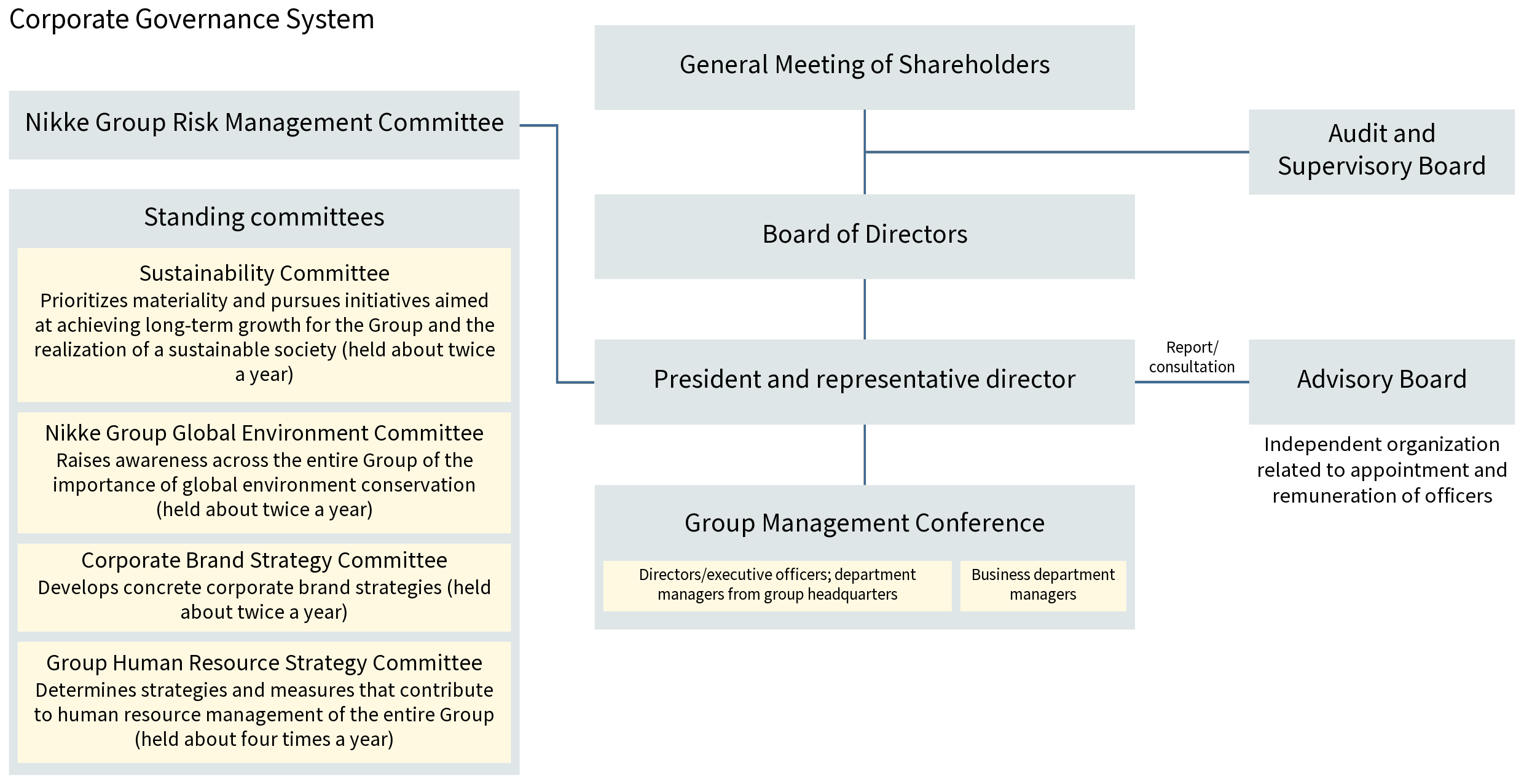
The Company has chosen the institutional design of a company with an audit and supervisory board, in which the Board of Directors and the Audit and Supervisory Board supervise and audit business execution, and makes effective use of this structure. To complement the functions of the Board of Directors, we have established an “Advisory Board,” and have thereby built a “system for monitoring management” and a “system for selecting the most suitable managers” aimed at improving corporate value in the medium to long term. In addition, we have introduced an executive officer system to clearly separate management decision-making and supervisory functions from business execution functions and to revitalize corporate management by strengthening the business execution structure. Through these initiatives, we believe that our governance system is functioning effectively.
1. Board of Directors
The Board of Directors consists of eight directors (including three outside directors) who are balanced in terms of knowledge, experience, and capabilities and have diverse backgrounds. We appoint highly independent outside directors and ensure that at least one third of the Board members are outside directors, so that we can receive advice from various perspectives and strengthen the supervisory function. To invigorate the Board of Directors, we hold “liaison meetings between outside directors and Audit and Supervisory Board members” as needed, as a place for exchanging information and sharing perspectives among outside officers.
2. Audit and Supervisory Board
The Audit and Supervisory Board consists of four members (including two outside members) and meets monthly. We appoint highly independent outside Audit and Supervisory Board members, who conduct audits from an independent standpoint and provide appropriate opinions. Recognizing its fiduciary responsibility to shareholders, the Audit and Supervisory Board makes appropriate decisions from an independent and objective standpoint and strives to ensure the soundness of the Company for the sustainable improvement of corporate value. Audit and Supervisory Board members audit the decision-making process of the Board of Directors and the status of directors’ execution of their duties by attending meetings of the Board of Directors and other important meetings, hearing from directors, and reviewing important approval documents.
3. Advisory Board
As a mechanism for monitoring by, and receiving information from, outside experts, the Company has established an Advisory Board in which independent outside directors make up a majority. The Advisory Board receives reports from the Representative Director on the nomination and remuneration of officers and on matters fundamental to the management of the Company, and responds to consultation on them. It meets regularly twice a year and additionally as needed.
4. Group Management Conference
The Group Management Conference consists of executive officers, full-time Audit and Supervisory Board members, the heads of each business division, and the heads of Group headquarters departments. So that the Representative Director can make important decisions on business execution efficiently and optimally, it examines each matter through discussion from multifaceted and creative perspectives, and meets at least twice a month.
As part of the Company’s corporate governance initiatives to date, we have implemented the following reforms.
Established a special committee to ensure the reasonableness and fairness of the
“Policy on Response to Large-Scale Acquisitions of the Company’s Shares (Takeover Defense Measures)”