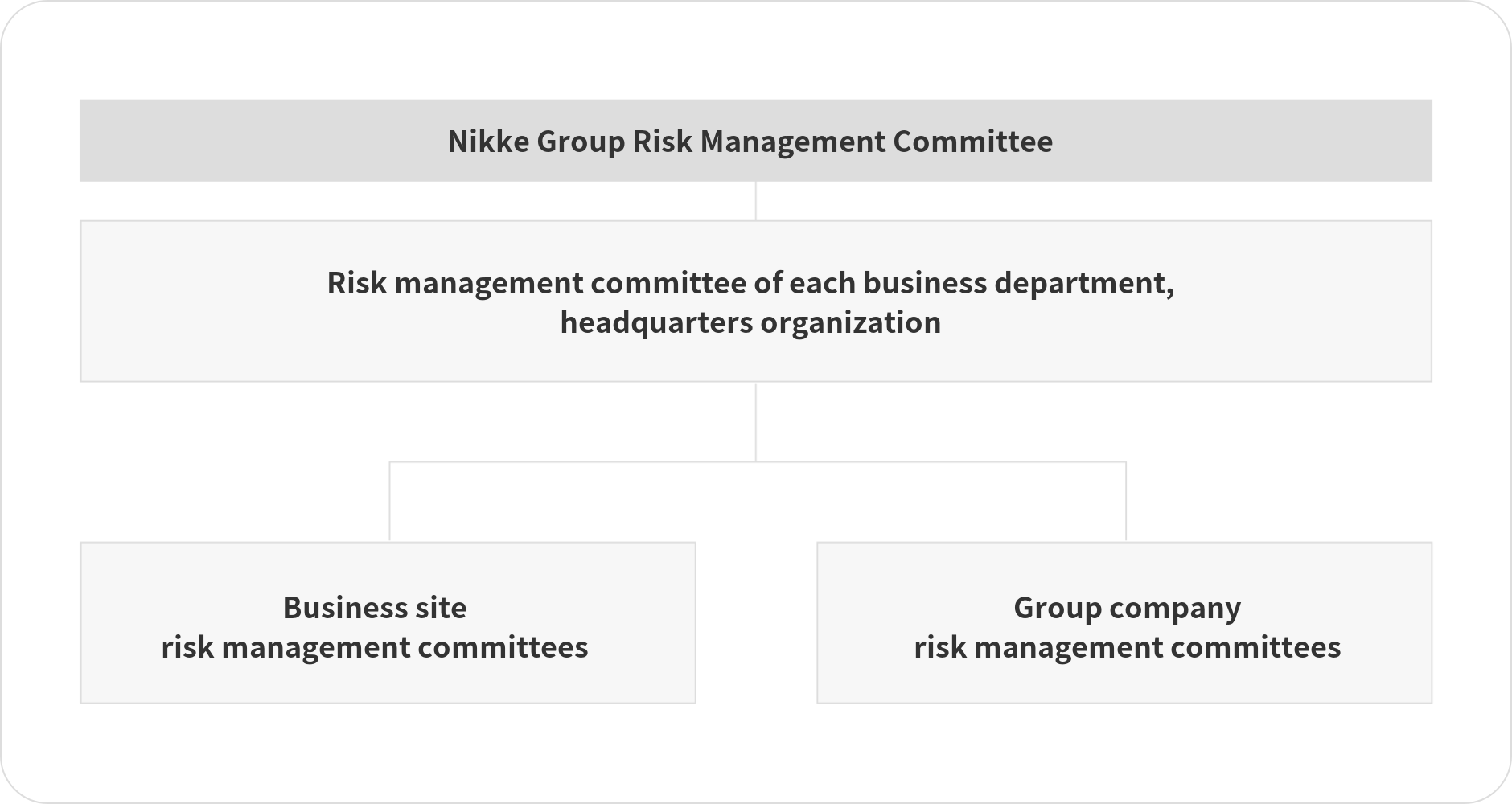
Risk Management Structure
The Nikke Group has established the Group Risk Management Committee to identify the risks recognized by the Group and strengthen the risk management system for preventing the risks and minimizing losses.
Business Risks
| NO | Major risk factors | Nature of the risk and anticipated impact | Response policy |
|---|---|---|---|
| (1) | Declining business results, business withdrawal of important business partners, etc. | Dependence of sales on specific business partners may lead to a sharp drop in sales due to deteriorating business results of those partners, requests for price reductions, etc., or to significant bad debt losses (in excess of allowances) due to a partner’s bankruptcy. | We work to reduce dependence on specific business partners by expanding and diversifying sales channels and business areas, set credit limits for each business partner, and transfer risk through trade credit insurance for some transactions. |
| (2) | Business reorganization, and improvement of business structure | When carrying out business reorganization or structural reform aimed at sustainable growth and improved profitability, temporary structural improvement costs (such as extra retirement payments and losses on disposal of equipment) are incurred. | We monitor the management environment and market trends from multiple perspectives and strive to carry out business reorganization and structural reform at the appropriate time. |
| (3) | Significant drop in stock prices, fluctuations in exchange rates, etc. | Valuation losses on securities and increased retirement benefit costs due to declines in the market value of cross-held shares and pension assets (invested shares), as well as higher procurement costs for raw material imports in the textile business due to significant exchange rate fluctuations. | We reduce risk through case-by-case examination by the Board of Directors of the rationale for holding shares, regular monitoring of pension assets, and optimization of investment allocation. We also hedge exchange rate risk through forward exchange contracts and other means. |
| (4) | Product defects, etc. | Payment of substantial damages and loss of the Group’s social credibility and brand value in the event of a serious product defect or malfunction. | We strengthen our quality control system in accordance with prescribed quality control standards and strive to prevent serious product defects, and we reduce the impact on business results and financial position by carrying product liability insurance. |
| (5) | Purchase of raw materials | Price surges and tight supply and demand for raw materials used in major products due to factors such as international market conditions, weather, and exchange rate fluctuations. | We strive to ensure stable procurement by promoting multiple sourcing and examining purchasing routes through global procurement. |
| (6) | Overseas business development | Serious disruption to production activities, etc. due to unexpected changes in laws and regulations or political or social turmoil in the locations of overseas production bases. | We strive to keep abreast of local conditions by maintaining constant, close communication with overseas subsidiaries, and reduce risk by obtaining advice from local experts. |
| (7) | Disasters, spread of serious infectious diseases, etc. | Serious disruption to production activities, etc. due to large-scale earthquakes, wind and flood damage, snow damage, fires, etc. In addition, the outbreak and spread of serious infectious diseases and the prolonged effects thereof may cause severe deterioration of market conditions, supply chain stagnation, and stagnation of business activities. | We have established related regulations on preventive measures and emergency responses assuming the occurrence of disasters, etc., and regularly conduct various drills. To address infectious diseases, we have introduced online tools and taken measures such as telework and staggered working hours. |
| (8) | Impairment losses on fixed assets | Because we make capital investments in equipment and carry out M&As as growth investments in various business fields, impairment losses on property, plant and equipment and goodwill may arise if profitability declines due to a sudden deterioration in the business environment or intensified competition. | We strive to reduce impairment risk by, for example, setting hurdle rates for investment efficiency and payback period at the investment decision stage. After investments are made, we closely monitor conditions in each business field and strive to maintain and improve profitability by providing high-value-added products and services. |
| (9) | Information security risks | Shutdown of major systems, destruction of important data, and leakage of information due to cyberattacks, unauthorized access, large-scale power outages, etc. | In managing information systems and networks, we focus on stable operation and security measures, and take measures such as appropriate server management, information backup, and cyber insurance coverage. |
Through audits by the Audit and Supervisory Board and the Internal Audit Department and Nikke Group Risk Management Committee meetings held twice a year, the Nikke Group aims to improve comprehensive group-wide recognition and sharing of the risks and conducts regular reviews on the risk management system. Business departments and group companies also hold risk management committee meetings to understand the risks unique to each business.
Structure of Nikke Group Risk Management Committee