
Disclosures Based on the TCFD Recommendations

Statement of Support
We at the Nikke Group regard environmental conservation as the top priority in corporate management so that we can hand down our irreplaceable global environment to the next generation. In 1993, we established the “Nikke Group Global Environment Committee,” and from an early stage we have worked on energy conservation, CO2 emission reduction, and reduction of the volume of waste sent to final disposal in every aspect of our corporate activities, including research and development, manufacturing, sales, and logistics.
Today, the impacts of climate change, such as extreme heat and torrential rain, pose a threat to our everyday lives, and the IPCC and other relevant organizations have repeatedly warned of the acceleration and severity of these impacts and the urgency of responding to them. The Nikke Group believes that action can no longer wait, and we have now decided to express our support for the recommendations of the Task Force on Climate-related Financial Disclosures (TCFD).
Under our corporate philosophy, “As a corporate group that is gentle and warm toward people and the planet, we will take on challenges with passion and pride,” the Nikke Group will continue to focus even more strongly on climate change initiatives and to continuously expand our information disclosure.
History of Environmental Conservation Activities
Began sales of “Ecologia Project” products using recycled PET bottle fibers
and the “Medium-Term Global Environmental Conservation Plan”
Converted the Environmental Report into the “Environmental Data Collection” and made it fully web-based
Established “Eco Ship,” a recycling system for used uniforms
Began aggregating Scope 3 emissions (Nikke on a non-consolidated basis)
F&A Nonwovens Corporation entered into a business partnership with ECOMMIT Co., Ltd. and JEPLAN, Inc. on resource circulation of used clothing
Jointly proposed, and was selected for, “Research, Development, and Demonstration for Establishing a Fiber-to-Fiber Resource Cycle” under NEDO’s publicly solicited “Bio-Manufacturing Revolution Promotion Project”
Policy on Climate Change Initiatives
Nikke Group SDGs Vision
As a corporate group that is gentle and warm toward people and the planet, the Nikke Group will take on challenges with passion and pride and contribute to the realization of a sustainable society and the resolution of social issues.
<Nikke Group Basic Environmental Philosophy>
Based on our corporate philosophy, the Nikke Group has adopted as its basic environmental policy “to aim to be a corporate group trusted by society through consideration for the environment and high corporate ethics.”
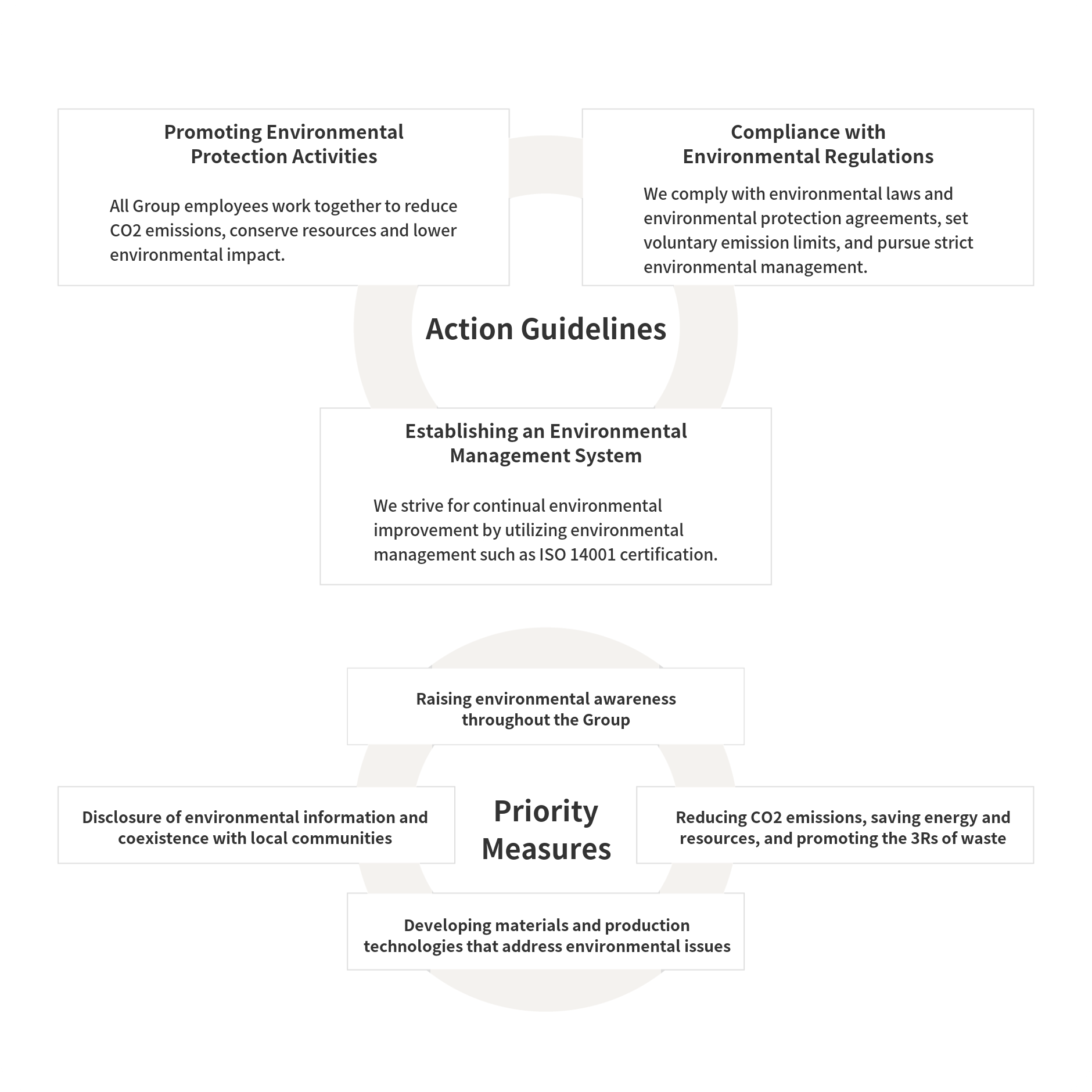
In particular, we regard conservation of the global environment as our most important issue, and we have established four priority measures and three action guidelines in order to carry out corporate activities toward realizing a prosperous and livable society.
All Group employees will actively engage in environmental conservation activities in every field, from research and development to manufacturing, technology, sales, and distribution.
Action Guidelines and Priority Measures
Governance
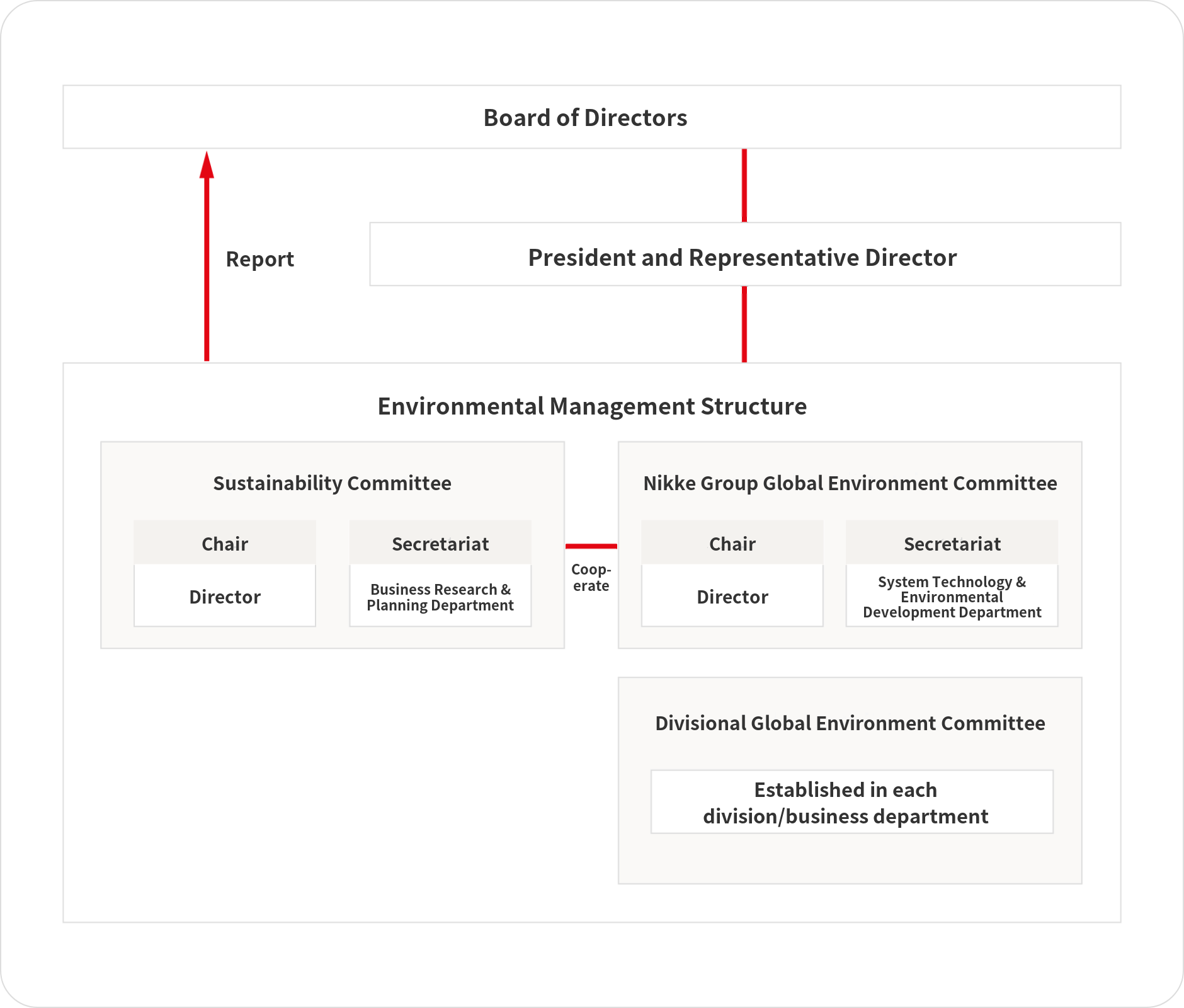
Aiming for the Group’s perpetual growth and the realization of a sustainable society, the Nikke Group established the “Sustainability Committee” in February 2022 in order to recognize and promote initiatives on the key issues (materiality) set out in the Corporate Governance Code, beginning with consideration for global environmental issues such as climate change.
On global environmental issues, the Sustainability Committee analyzes risks and opportunities and reflects them in management strategy. The Sustainability Committee is chaired by a director, and the results of its deliberations are appropriately reported to the Board of Directors.
In addition, the “Nikke Group Global Environment Committee” is responsible for setting indicators and targets related to global environmental issues such as greenhouse gas reduction, examining technologies for implementation, and measuring and monitoring results, in coordination with the Sustainability Committee. Specific action plans are drawn up and carried out by the “Divisional Global Environment Committees” established in each division and business department.
The chair of the “Nikke Group Global Environment Committee” is a director.
Organizational Chart
Strategy
The Nikke Group analyzed transition risks assuming a 1.5°C scenario, physical risks assuming a 4°C scenario, and opportunities across all of its business areas.
The scenarios referenced are as follows.
Transition Risks
1.5°C Scenario
Reference scenario: IEA (International Energy Agency) Net Zero Emissions Scenario (NZE)
Physical Risks
4°C Scenario
Reference scenario: IPCC (Intergovernmental Panel on Climate Change) RCP8.5 scenario
The timing of realization and the degree of impact are assessed using the following guidelines.
| Timing of realization | Guideline |
| Short term | Approximately 10 years |
| Medium term | Approximately 10 to 20 years |
| Long term | Approximately 20 to 30 years |
| Impact | Guideline |
| High | A decline of 30% or more in divisional sales or 50% or more in operating profit |
| Medium | A decline of 10% or more in divisional sales or 30% or more in operating profit |
| Low | A decline of less than 10% in divisional sales or less than 30% in operating profit |
Under the 1.5°C scenario, rising energy and materials costs and a greater cost burden from environmental measures and carbon taxes are anticipated, and a corresponding impact is expected on the Textile & Clothing Materials Division and the Industrial Machinery & Materials Division, which have manufacturing functions, and on the Human & Future Development Division, which operates commercial facilities and engages in real estate development. In addition, as demand grows for environmental performance and the adoption of low-carbon materials, costs may increase due to the need to develop new materials and restructure the supply chain.
Under the 4°C scenario, as storm and flood damage grow in severity, some factories and commercial facilities may be affected, resulting in losses due to shutdown as well as recovery costs. Also, if droughts or similar events occur in wool-producing regions, procurement could be disrupted.
On the other hand, in terms of opportunities, the solar power generation facilities we own nationwide already contribute to the growing demand for green energy, and in the future we will also consider using them for our own consumption to reduce our energy costs and for carbon offsetting. We believe the Nikke Group can achieve sustainable and steady growth by providing services and products that are chosen by customers and contribute to society, such as the development of low-environmental-impact office buildings and rental housing and the pursuit of a circular economy for wool materials.
| Category | Timing | Impact | Description | Current initiatives | |
| Transition | Policy, regulation, and technology | Short to medium term | High | Increase in direct energy costs at large-scale commercial facilities such as factories and shopping centers | Optimization of energy efficiency at each facility and piece of equipment; energy creation through solar power generation; introduction of renewable energy |
| Medium to long term | Medium to High | Decline in the value of facilities and equipment that use fossil energy Possible increase in environmental investment and R&D expenses | |||
| Market and reputation | Short to medium term | Medium to High | If we cannot meet consumer expectations for lower carbon, our corporate brand may be damaged and competitiveness may decline Soaring raw material costs | Accurate understanding of consumer purchasing behavior Active development of environmentally friendly products Monitoring of raw material manufacturers and industry trends | |
| Medium to long term | Medium to High | We may receive requests from suppliers and customers to reduce CO2 emissions, mainly in B2B businesses Possible increase in environmental investment and R&D expenses | |||
| Physical | Acute | Short, medium, and long term | High | Possible damage to some facilities, equipment, and inventory from severe storms and floods | Strengthening of the BCP system and monitoring by the Risk Management Committee of the status of system development Reconstruction and relocation of R&D facilities |
| Medium to long term | High | Reduced ability of outdoor facilities to attract visitors due to extreme heat Shutdown of commercial facilities and factories due to tight electricity supply | |||
| Chronic | Medium to long term | Medium | Decrease in wool output and decline in quality Higher costs of maintaining working conditions and inventory quality at factories Greater burden of managing the health of users at nursing care and childcare facilities | Diversification of raw material procurement Stronger cooperation with local medical institutions; improvement of facilities at nursing care and childcare facilities | |
| Opportunity | Resources and energy sources | Medium term | Medium to High | Reduced energy costs and carbon offsetting through the use of solar power generation facilities Cost reduction through recycling of products CO2 reduction through innovation in production technology | Considering future in-house use of the solar power generation facilities that currently sell electricity Promotion of circular economy initiatives (business partnership on resource circulation of used clothing in the industrial materials field; launch of the “WAONAS™” wool garment circulation project in the clothing materials field) Joint participation in NEDO’s “Research, Development, and Demonstration for Establishing a Fiber-to-Fiber Resource Cycle” project Introduction of equipment for automatic removal of foreign objects in used-clothing wool reclamation Expanded introduction of production equipment for the environmentally friendly innovative spun yarn “Breeza®” |
| Products, services, and markets | Medium term | Medium to High | Improved competitiveness through low-carbon real estate development Growing preference for low-environmental-impact products may strengthen the brand power and competitiveness of wool itself, a natural material, and of our high-performance products. Improved customer evaluation through reduced CO2 emissions in manufacturing processes | Adoption of low-carbon design (ZEB and ZEH specifications) in the Tokyo Building redevelopment (Yaesudori Fil Terrasse) and in rental housing development Increased production capacity and expanded global sales of “ADMIREX®,” a high-performance filter bag for applications such as waste incineration facilities Promotion of circular economy initiatives Introduction of equipment for automatic removal of foreign objects in used-clothing wool reclamation Expanded introduction of production equipment for the environmentally friendly innovative spun yarn “Breeza®” Expanded procurement of “ZQ-certified (*)” raw materials (*) A system in which a third-party organization audits wool raw materials against strict criteria such as “animal welfare,” “environmental consideration,” “work safety,” and “employment environment,” and then certifies them | |
Risk Management
The Nikke Group has established the “Group Risk Management Committee” directly under the President and Representative Director to identify the risks recognized by the Group and to strengthen the risk management system aimed at preventing risks and minimizing losses.
About Our Risk Management System
Indicators and Targets
The Nikke Group aims to reduce Scope 1 and 2 CO2 emissions by 50% by fiscal 2030, compared with the fiscal 2018 base year. In addition, toward the achievement of carbon neutrality by fiscal 2050, we will consider every option, including reducing energy use through the renewal of factory production equipment, utilizing existing solar power generation facilities and installing new ones, and expanding procurement of green energy.
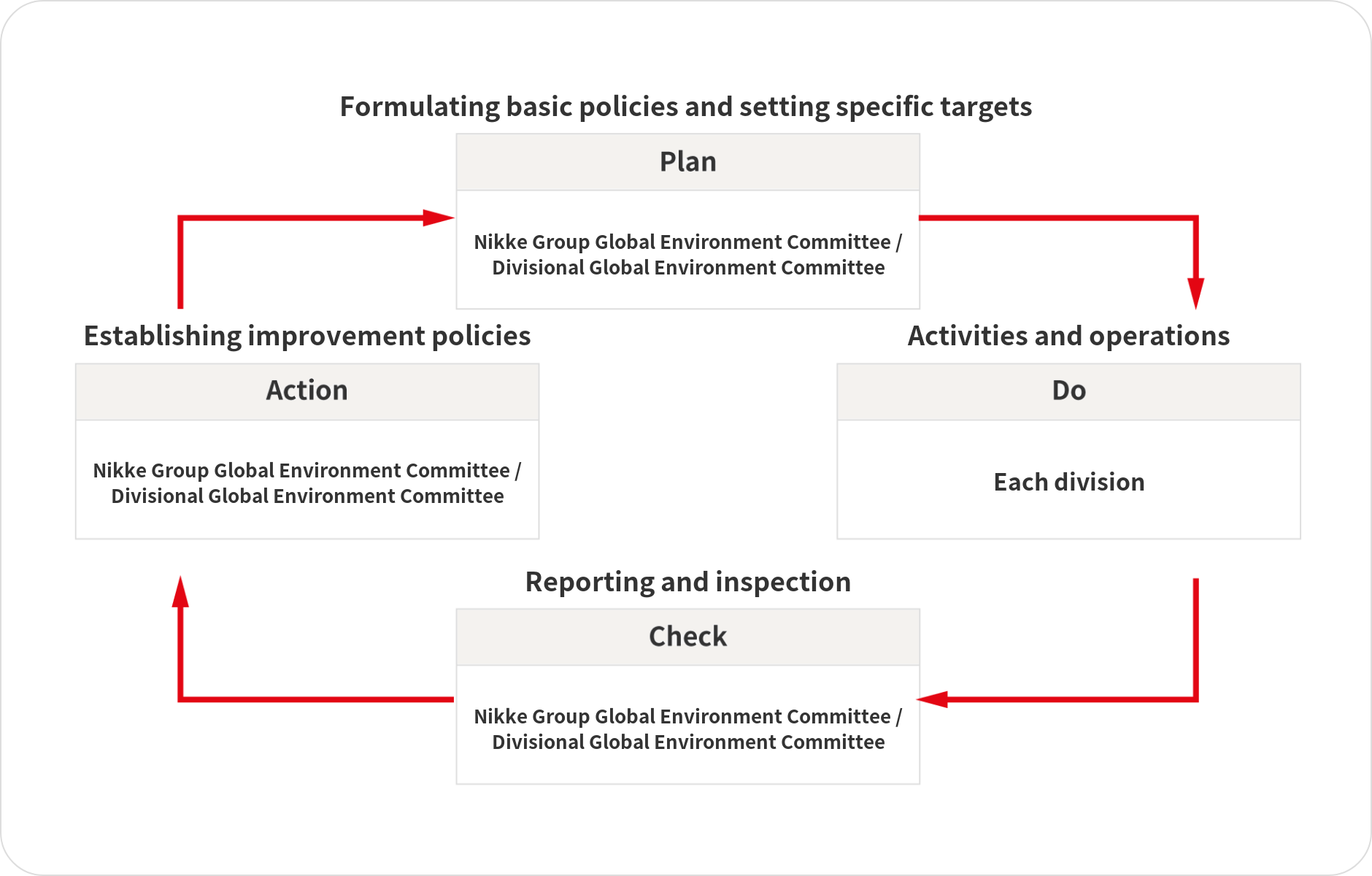
We will advance these efforts through the “Nikke Group Global Environment Committee” by repeating a PDCA cycle of setting basic policies and specific targets, carrying out activities and operations, reporting and reviewing, and formulating improvement policies.
Flowchart for Promoting Environmental Conservation Activities
Consolidated CO2 Emissions Results [Scopes 1 and 2]
- In the Textile & Clothing Materials business, emissions fell compared to the base year, partly due to the exclusion of Jiangyin Nikke Worsted Spinning Co., Ltd. from consolidated results following a divestment of equity interest in fiscal 2019.
- In the Industrial Machinery & Materials business, emissions increased compared to the base year due to the inclusion of results for consolidated subsidiary Fuji Corporation (*2) from fiscal 2022 and consolidated subsidiaries Kankyo Techno Co., Ltd. and Kureha Ltd. from fiscal 2025.
- The Human & Future Development business saw a decrease compared to the base year due to a reduction in the number of stores accompanying downsizing of the communications and franchise businesses, as well as the effects of corporate PPA agreements and purchasing renewable energy.
- For the Nikke Group as a whole, while there will be some impact from increases and decreases in the emission factors of electric power companies, we are working toward our goal of a 50% reduction by fiscal 2030 by continuing to promote CO2 emission reduction measures such as reducing energy use through replacing production equipment with energy-efficient and streamlined systems, expanding and using solar power systems, and purchasing renewable electricity.
*1 Fiscal 2018, when we began aggregating Scope 1 and 2 data for all business sites of all consolidated companies, has been established as the base year.
(*2) As part of the business restructuring in fiscal 2024, the nonwoven fabric and felt business was integrated into Ambic Co., Ltd. (now F&A Nonwovens Corporation) and then merged with Nikke.
| (Unit: t-CO2/year) | FY2018 (Base year *1) | FY2025 results |
| Textile & Clothing Materials | 33,593 | 14,197 |
| Industrial Machinery & Materials | 9,544 | 14,048 |
| Human & Future Development | 11,100 | 5,381 |
| Consumer Goods & Services | 441 | 373 |
| Others | 20 | 159 |
| Total | 54,698 | 34,158 |
[Rate of change] -37.6%
Scope 3 CO2 Emissions Results [Nikke Non-consolidated]
- Starting in fiscal 2022, we began compiling results in six categories that we believe have a significant impact on Scope 3, covering the major business locations of Nikke on a non-consolidated basis (manufacturing sites, shopping centers, rental facilities, etc.).
- We will continue to work to expand the target business locations, categories, and items.
| (Unit: t-CO2/year) | FY2025 results |
| Total (*) | 44,131 |
* Categories 1 (purchased goods and services), 2 (capital goods), 3 (fuel- and energy-related activities), 4 (upstream transportation and distribution), 5 (waste generated in operations), and 13 (downstream leased assets) are tallied.
Scope 1: Direct greenhouse gas emissions by the business itself (fuel combustion, industrial processes)
Scope 2: Indirect emissions from the use of electricity, heat, and steam supplied by other companies
Scope 3: Indirect emissions other than Scope 1 and Scope 2 (emissions of other companies related to the business’s activities)